

I sat across from Marty Cagan on a video call a few weeks ago, and at one point he said something I wrote down as inspiration for this piece.
We were talking about why, after more than twenty years of writing and coaching and speaking, most companies are still not operating the way the evidence says they should. Still running feature teams. Still treating product management like project management. Still measuring velocity over value. And he paused, in the way people pause when they are about to say something they have said many times but still believe completely, and said:
“There is a level of arrogance behind this. CEOs are pretty sure they know what to build. But they don’t. And they’re not humble enough to realize they don’t.”
He was not saying this to be provocative. He has been watching the same pattern repeat for two decades: the problem is rarely a lack of capability, it is a lack of culture. The talent exists. The tools exist. The frameworks exist, more of them than anyone could ever need. What does not exist, in most organizations, is the environment that allows talented people to actually do the work.
This is the piece I want to write. Not about the frameworks. About the environment.
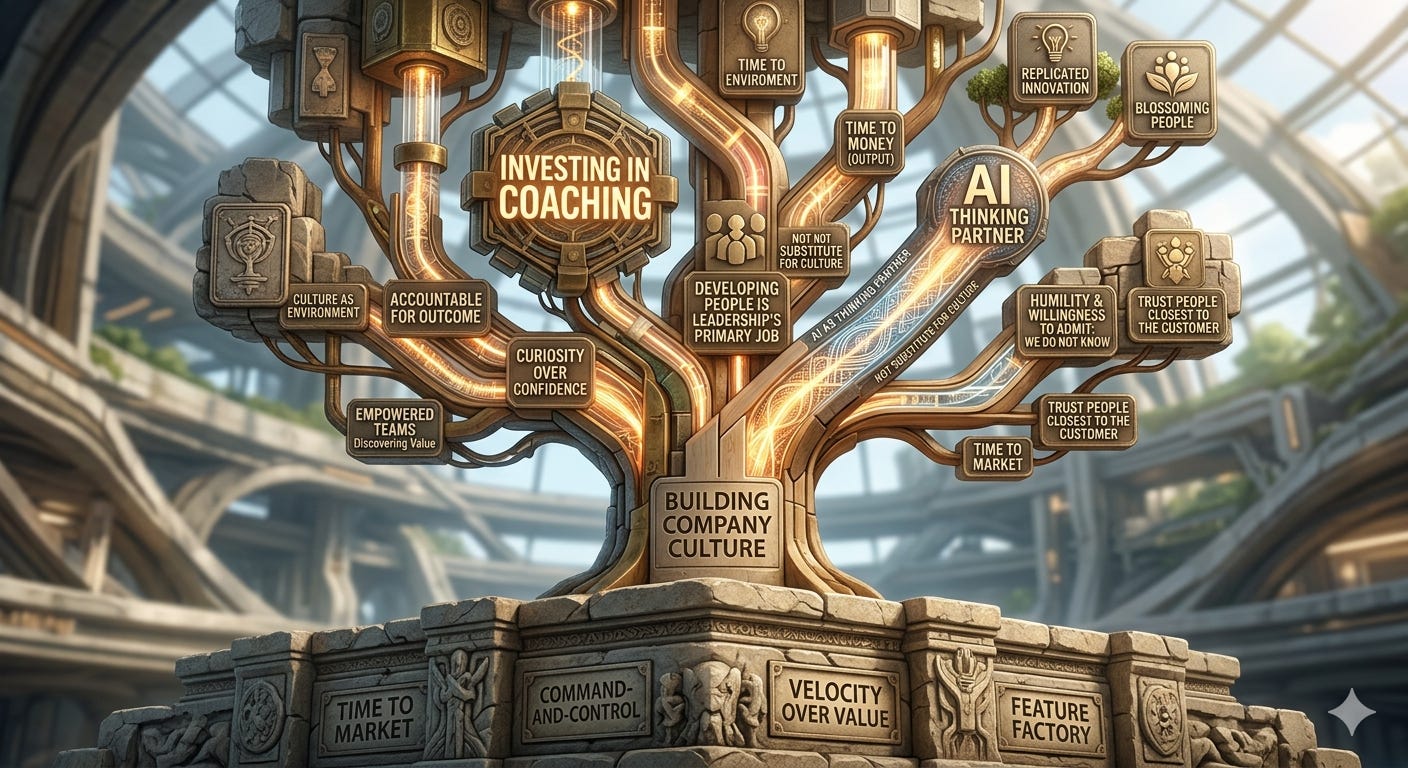
Some of you will be overjoyed to know I ‘partnered with AI’ (Nano) to generate this image for this article, because that’s what I felt like allowing it to do today for me. Anyway…
Time to Market vs Time to Money
Marty painted the clearest picture of the culture problem I have seen in a while.
Most companies, when they talk about the value of moving fast, are talking about time to market. How quickly can we get this feature out the door? How many releases can we get in a quarter? How fast can we go from idea to ‘ship it’?
Lots of companies are thinking about time to money. How quickly can we get something into customers’ hands that generates the outcome we need? And those two things are not the same. A fast release of the wrong thing does not bring you closer to time to money. It moves you further from it.
“Speeding up time to market, if it’s the wrong product, is not going to give you the money. They don’t realize that.
The reason this distinction matters so much right now is that AI has removed the engineering bottleneck that used to obscure it. For years, leaders could tell themselves the problem was speed. Engineers could not build fast enough. The roadmap was too long. The cycle time was too slow.
That argument is no longer available. Teams can build faster than ever. And they are finding out, in real time, that building fast does not mean building right. The bottleneck was never the engineers. It was always the quality of the thinking about what was worth building.
Most companies are using AI to turbocharge the old way of working. They are building the same things, just faster. The question is not how fast. It is what.
The Coaching Culture Gap
Marty spent the first decade of his career at HP Labs. He described it as the most innovative company in the world at the time, with a reputation like Google has today. And when he left, he realized something that had never occurred to him while he was there.
Every single day at HP, someone was assigned to help him get better at his job.
He thought this was normal. He thought every company did this. He did not realize until he got somewhere else that almost no one does this. That the culture of deliberate, daily coaching that made HP what it was is genuinely rare, and that most product people spend their entire careers without ever experiencing it.
Google’s Project Oxygen research, which began in 2009 and has been validated repeatedly since, found that the number one trait of the best managers at Google, as measured by their own employee surveys and performance data, was being a good coach. Not the sharpest strategist. Not the most technically fluent. A good coach. The person who invests in helping others become better. (Source: Google Project Oxygen, updated 2018, re-validated across thousands of teams.)
Apple lists coaching as one of its four leadership pillars. It is a core principle in Amazon’s leadership framework. These are not coincidences. They are the output of organizations that figured out something most companies are still pretending they do not need to figure out: that developing people is the primary job of leadership, and that outcomes follow from that, not the other way around.
“The best companies are very public about their commitment to coaching. Google says, every year in their employee survey, the number one trait of a good manager is being a good coach. That’s the culture that actually produces the outcomes everyone says they want.”
What Marty is describing is structural. The companies that consistently build great products have built an environment where getting better at the work is treated as part of the work. Where a product manager is expected to grow, and someone is accountable for making that happen. Where discovering you need help is not a failure. It is a starting point.
The Catch-22 Nobody Talks About
Here is the version of this problem I hear most often from product leaders, and the one worth naming.
Companies want to move to the product model. They have read the books, attended the conferences, used the vocabulary. They know that empowered teams produce better outcomes than feature factories. They want the results.
But the managers who are supposed to lead those empowered teams have never worked this way themselves. They were formed in the project model. They were rewarded for output, not outcome. They learned to manage by being managed that way. And now they are being asked to coach their teams into a way of working that nobody coached them into.
“If my manager’s never worked this way before, how do I learn? The manager can get a coach. But then some managers don’t want to. Some don’t have time because now they have twice the number of reports. So we really didn’t have a good answer to how do you learn this stuff.
Until gen AI.”
He is optimistic that AI changes this equation. Not because AI replaces the coaching relationship, but because it makes a certain kind of learning available at any hour, in any context, to anyone with a connection. The product manager in a company that has never built this way before can now get access to a thinking partner who will push back on their reasoning, ask the questions a good coach would ask, and help them develop product sense in a way that was simply not accessible before.
But he is also clear-eyed about the limitation. AI can accelerate learning. It cannot substitute for a culture that values it. If the organization rewards speed over quality, features over outcomes, confidence over curiosity, the tool does not fix that. The tool amplifies whatever environment it operates inside.
What the Companies Getting This Right Are Actually Doing
Marty has spent more than twenty years inside the companies that consistently build great products, and he is direct about what separates them from the ones that do not.
It is not the talent, at least not primarily. He said this explicitly: he has seen people with tremendous potential wasting away in the wrong culture, frustrated, checked out, good at the job they have never actually been asked to do. He regularly makes calls to connect those people with companies that will actually develop them. His favorite for this, he said, is Google. Because once someone is in that environment, it usually takes just a few months before they start to blossom.
“It’s not the person. It’s the culture they were in. And my goal is to get more companies to embrace the cultural elements of the companies that have consistently replicated and innovated. Because it works. It keeps working.”
The companies that replicate this do a few specific things:
They treat the development of their people as a leadership responsibility, not a HR function or a checkbox.
They create explicit space for coaching, not just the annual review and the occasional 1:1.
They measure managers on whether their teams are growing, not just whether they are shipping.
They also, and this matters more than people want to admit, hire for culture fit at the leadership level. Not personality fit. Not culture add. They are looking for leaders who have actually worked this way, who have experienced what it feels like to be coached into excellence, and who therefore know how to extend that to the people they lead.
The Gallup State of the Global Workplace 2025 report found that global employee engagement fell to 21% in 2024, the lowest since the pandemic. The cost: an estimated 438 billion dollars in lost productivity. And what Gallup found when they looked at what drives engagement was not compensation or perks or mission statements. It was the managers. Specifically, managers who coach, who develop, who create the conditions for people to do their best work. The research was unambiguous: when managers are equipped and supported to lead that way, engagement goes up. Retention goes up. Performance goes up.
None of this is new information. The research has been clear for a long time. What remains rare is the organizational will to act on it.
The Command-and-Control Problem
We talked about the cultural force that holds most companies back with openness and honesty.
In the United States the most common model is command and control, even in companies where nobody wants to admit that. The CEO or the leadership team is pretty sure they know what needs to be built. The roadmap comes from the top. The product team’s job is to execute it. And if only it could be done faster, everything would be fine. Right?
This is why so many companies have seized on AI velocity as the solution to a problem that velocity cannot fix.
If the issue is that leadership is making the wrong calls about what to build, building those wrong things faster does not help. It accelerates the failure.
He shared this very important fact: the difference between feature team product managers and empowered product team product managers is not the title. It is the accountability. Feature team PMs are accountable for output. They deliver what they are told to deliver. Empowered product PMs are accountable for outcome. They are responsible for whether the thing they built actually solved the problem.
Most organizations say they want the second kind. Most organizations are actually structured for the first. The culture has not caught up with the vocabulary.
Companies that want the outcomes of the product model but maintain the structure and incentives of the project model are not transforming. They are performing transformation. That is different. And it costs them.
What Leaders Actually Need to Do
I’ll end with something practical. Most people think this type of thing is philosophical rather than operational, so here you are.
Marty is clear that the transformation to a real product culture requires leadership to do something most of them find uncomfortable: let go of the certainty that they know what to build. That requires humility. Not as a character trait but as a practice. A deliberate choice to trust the people closest to the customer over the instinct of the person furthest from them.
It also requires investing in coaching as a first-class activity. Not as a budget line item that gets cut when the quarter gets hard. Not as a perk for top performers. As the mechanism through which everyone in the organization gets better at the work. Marty had someone assigned to help him get better every single day at HP. That was not expensive. It was cultural. And it produced one of the most enduring product practices in the history of the industry.
It requires measuring managers on the right things. Not just whether the team shipped. Whether the team grew. Whether the people on it are better at discovering and delivering value than they were a year ago.
And it requires patience. The companies that have done this well, Apple, Google, Amazon, Netflix, did not get there in one transformation initiative. They got there by making coaching and development the consistent expectation over years, until it became the way things work rather than the initiative of the quarter.
“There’s enough people that really do have the passion and the product sense. That’s sort of what gives us hope. And there will be more. Because the tools have never been better for developing this stuff. But the environment has to allow it.”
The tools are better than they have ever been. The research is clearer than it has ever been. The case for doing this is stronger than it has ever been.
What is still missing, in most organizations, is someone at the top willing to admit that they do not already know the answer. This is the most courageous and wise thing they can do. And to then build a culture that treats figuring it out together as the actual work.
This piece is drawn from a longer conversation with Marty Cagan for the TPH Spotlight series. The full human piece, covering his father, the computer center, HP Labs, Netscape, and what he most wants this community to understand, is published separately.