

Ramli John and I have been in each other’s orbit for a while now. The kind of orbit that comes from genuinely caring about the same things - the craft of product, the people doing the work, and the community that holds all of it together. I have proudly pushed his Product Led Onboarding book to any customers I’ve consulted for or companies I’ve worked in. When I reached out about this Spotlight, it felt less like pitching a stranger and more like finally making time for a long overdue conversation, after years of just ‘working together’ on community events, and seeing that iconic confetti (keep scrolling ✨).
What I want you to know before we get into any of this is that Ramli is one of the people in our space who has been building with integrity for a long time, quietly and consistently, without needing the moment to be about him. In addition to the book above, he wrote another, Eureka, both of which tens of thousands of product teams actually use. He taught for years. He has mentored more people than he probably remembers. And right now, at a moment when every product leader I talk to is exhausted and slightly terrified, he is building something that genuinely helps.
This one is for the people who are doing the real work while seeing the people alongside them who are as well, and wondering if anyone notices. Someone does.

Education and Professional Highlights
Currently: Founder, Delight Path - consulting and peer community for product leaders navigating the AI era.
Before that: Content Director at Appcues. Managing Director at ProductLed. Growth consultant to Mixpanel, Zapier, Vidyard, and more.
Books: Product-Led Onboarding (40,000+ copies sold worldwide) and EUREKA: The Product Onboarding Playbook for B2B Companies.
Originally from: The Philippines. Moved to Toronto at age 10. Has called it home for exactly 30 years.
Education: Bachelor of Mathematics, University of Waterloo. MBA, Richard Ivey School of Business.
Career arc: Developer → data analyst → Pepsi → co-founder (failed startup) → freelance consultant → teacher → author → ProductLed → Appcues → Delight Path.
Community: Founder of the Product Leaders Lab - a peer community for VPs, Heads, and Directors of Product who are done pretending they have it all figured out.
I am proudly a member.
Where He Came From
Ramli grew up in the Philippines, moved to Toronto at ten years old, and has been there for thirty years since. He said that number - thirty years exactly - with the quiet satisfaction of someone who found his place and knows it.
As a kid, he was a nerd. He said it himself, without hesitation or apology. Video games, Rubik’s cubes, puzzles. Not the kid getting picked first in gym class, but the kid with his people, solving things for fun. He went to the University of Waterloo to study math with ambitions of becoming Einstein, collided with the reality of how hard physics actually is, and landed with a degree in mathematics and computer science that turned out to serve him far better than any physics Nobel would have.
I want to stay on the teacher story for a moment - it’s a thread here.
Ramli’s best teacher in high school started every class by asking students what they wanted to be when they grew up. And then, for the entire semester, he connected every lesson to those answers. Not loosely. Specifically. You want to be a police officer? Here is exactly how force and mass and acceleration show up in your career. It stopped feeling like numbers on a blackboard and started feeling like something worth paying attention to.
“I felt heard. And it stopped feeling like numbers on a blackboard. It felt real.”
That teacher is the reason Ramli briefly wanted to be a physicist. He is also the reason Ramli became a teacher. And if you look at everything Ramli has built since - books, courses, community, consulting - you will see that same instinct running through all of it. Make it real. Connect the lesson to the person. Earn trust before you ask someone to change.
That is not a framework. That is a value system that started in a high school classroom.
How Product Found Him
Ramli did not set out to work in product. He set out to build things, and product is what happened when he started paying attention to who those things were for.
After university he was coding, analyzing data, working in systems at Pepsi. Then he and a friend decided to start something. They built a platform for parents to create digital scrapbooks of their kids. Two guys in their twenties. Neither of them parents. No domain expertise, no distribution channel, a monthly meetup group, and a genuinely good idea that landed on the wrong founders for the job.
It failed.
I love that he told this story the way he did - not as a wound, but as the lesson that cracked everything open. Because the failure handed him the insight that has defined his entire career since: “It’s always been easy to build something. What makes it hard is figuring out who it’s for and how you reach them. That has not changed. If anything, AI has amplified the problem.”
He is right about that. In a world where you can prototype an app in an afternoon and launch something before the week is out, the people who understand distribution, empathy, and the difference between a stated problem and a real one are going to be the ones who build things that last. Ramli has been teaching this for years. It is more relevant now than it has ever been.
From the startup he moved into consulting, then teaching at RED Academy, CXL, and Centennial College, then writing, then the ProductLed world with Wes Bush, then Appcues, and now Delight Path, which he launched in late 2024. Every chapter has been a variation on the same theme: get close to the people, find the real problem underneath the stated one, and help them get to value faster.
The PM Mindset Outside of Work
This is the section I look forward to most in every conversation, and Ramli delivered.
I asked him whether the way he thinks at work ever bleeds into the rest of his life, and he went straight to first principles thinking. He described applying it not just to product problems but to parenting, to decisions, to anything that feels tangled. Strip it back. What are we actually trying to do? Why does this matter? How do we break it into smaller pieces?
He said he teaches his kids the same way. Take away everything. Start from what you know to be true. Then build from there. It is the same instinct his math degree gave him, the same thing coding gave him, and it travels into every part of his life now without him having to think about it.
But the moment that really landed for me was something quieter. He told me about a situation with a former colleague who felt hurt by something he had said. He heard about it, and he had two options. A Slack message - fast, easy, done - or a video call, which required coordinating schedules and sitting with the discomfort a little longer.
He chose the video call.“Even though it required coordinating and getting everyone together, I really feel like seeing the human behind the conversation matters. That’s important to me. Not just sending a text.”
Today, AI is compressing timelines and communication and everything in between, so choosing to slow down and do the human thing on purpose is itself a form of product thinking. It is understanding that trust is built in the spaces where you choose presence over convenience. And that the outcome you are optimizing for is the relationship, not just the resolution.
That is the product mindset outside of work. And that is the whole thesis.
The Craft: What Most Companies Still Get Wrong
Ramli has worked with hundreds of teams on onboarding and product-led growth. If you ask him what the single most common failure mode is, he does not hesitate.
Teams jump to the how before they understand the why. They see a competitor launch a new feature or a product tour and immediately want to do the same. They hear about a chatbot and add it to the backlog. They have a CEO who has just spent an afternoon in Lovable and suddenly the whole roadmap is in question. And none of it is grounded in an actual understanding of what the user is struggling with - not just functionally, but emotionally, socially, the whole picture. “One second. Let’s figure out the why. Why are we doing this? What is at the core of it? And then get to it.”
He said AI has amplified this problem significantly, not created it. When building was hard, there was a natural forcing function - you could only pursue so many wrong ideas at once. Now you can pursue all of them simultaneously, in a week, with a small team, and still call it a roadmap. The discipline of stopping before the build to understand the person has never mattered more, and it has also never been harder to protect.
This is why he has spent so much time thinking about teaching as a design discipline. When he was in the classroom, he was doing the same thing he does in product: figuring out who this person is, what they actually care about, what success looks like for them specifically, and then building the experience around that understanding. The lesson is not the content. The lesson is the connection.
On AI, the Space Right Now, and What Is Actually Hard
Ramli is not performing optimism about AI. He is not performing alarm either. He is doing the harder thing, which is sitting honestly inside the contradiction - it is genuinely useful and genuinely overwhelming, and both of those things are true at the same time.
Where it is actually helping
AI has become a real thinking partner for him. It helps him pressure-test ideas, challenge assumptions, brainstorm options he would not have reached alone. The administrative compression has been significant - he mentioned Granola, which we both use and love, as the kind of tool that gives back cognitive space by handling things that used to drain it. And the ability to prototype real, clickable experiences without a design team has changed what is possible in early-stage conversations with clients.
Where the real problem lives
The pressure, the saturation. That is where it gets hard.
Every morning on LinkedIn there is a new announcement that you are already behind. If you are not 5x more productive than last year, you might not have a job next year. If you are not using Claude Code, Cursor, co-pilot, agents, and whatever launched this morning, you are falling behind people who are. He called it an AI education race - everyone acquiring as much knowledge as possible just to feel current. I empathize with him here as the exhaustion is real because acquisition is not the same as absorption. “There’s a difference. And I think that’s where the exhaustion lives.”
This is exactly why he built the Product Leaders Lab Community. He kept hearing the same thing from product leaders across companies, levels, and industries: I feel behind. I feel like I am always trying to catch up. And what he found, by actually sitting with these people and putting them in rooms together, was that the hype is not the reality. Most people are in the same place. Most people are figuring it out as they go.
The algorithm is selecting, the same way instagram does. More on Product Leaders Lab below.
What he would tell product leaders right now
He said something that I want to put in front of every leader who has been feeling the weight of this moment.
“The human side is what differentiates.”
Not the tools. Not the speed. The judgment, the empathy, the ability to get to the root of what someone actually needs - these are the things AI does not do and cannot do, and they are going to matter more as the build-everything-instantly era unfolds, not less. The people investing in those things now are the ones who will be standing when the dust settles.
What Product Managers Should Be Measuring
When I asked Ramli about metrics, he started where I hoped he would - not with a number, but with a question. Before you can measure anything, everyone on the team has to agree on what value actually means for your users. What are they trying to do? What is their real motivation? Once you have that, the metrics fall into place naturally. Without it, you are measuring the wrong things confidently.
Time to value matters. But the instinct to minimize it, to sprint users to the aha moment as fast as possible, misses something that has become more important in the AI era, not less. He introduced a frame I had not heard this clearly articulated before:
“Time to trust. How long does it take them to trust the product enough to keep coming back? You can rush someone to value and still lose them because you never gave them a reason to believe.”
Time. To. Trust.
Retention is the north star it has always been. But trust is what retention is built on now, and the question is not just are they coming back - it is do they believe enough in what you are building to stake their time on it again. That belief is built in the onboarding, and built in every experience before they ever reach the moment you call success. Check out his latest conversation on How to Ship AI products without losing customer trust here.
The People Who Changed Everything
He shared some of the members of his personal board of directors with me.
His high school physics teacher - whose name he did not share but whose approach stayed with him for decades - is the reason he wanted to study physics and the reason he eventually became a teacher himself. The man connected every lesson to what his students actually cared about. He made them feel heard. That is not a teaching technique. That is a philosophy, and Ramli has been living it ever since.
Mark Thomas is the person Ramli turns to when he needs a sounding board that will give him honest thoughts rather than comfortable ones. The people who will tell you how something actually is, without softening it into uselessness, are rare and worth holding onto.
Gia Laudi has played that same role in the Delight Path journey specifically - helping Ramli think through the next steps with the same direct honesty. He described both of them as people who were willing to be vulnerable first, which made it safe for him to be vulnerable back. That reciprocal honesty is what helped him find his footing in a hard season of building something new.
I want to sit on something Ramli said here that I think deserves more than a line. When I asked who had helped him most in the Delight Path chapter, he talked about people willing to be honest - and then he said the vulnerability piece, just the act of sharing something real, had been the thing that helped most. A lot of people in our space are afraid to let others in. Ramli has figured out that it is actually the move.
Why He Built It, and Why Now
The moment Ramli knew Delight Path was real was at a summit he hosted last year - the AI Product Leader Summit - where he started getting messages from people saying thank you for doing this and that they’re glad someone is finally sharing what is actually happening rather than what we read online.
He described watching people light up when they connected with each other in that room, recognizing something in someone else’s story, feeling less alone in what they were going through. That, he said, is what gives him energy. Not the keynote. Not the recognition. The moment someone in the room realizes they are not the only one. “I get a ton of energy when I connect people with each other. Seeing them light up and connect with others - that gets me excited. If I didn’t do this, something important would be missing.”
The Product Leaders Lab is the formalization of that instinct. A peer community, application-only, small cohorts, built specifically for the people who are leading product organizations through the most complicated moment any of us have ever navigated. Not a course. Not a framework. A room full of people who actually understand what the seat feels like right now.
*The cohort is open through April 23rd. If any of that sounds like what you have been looking for, go to delightpath.com and find out more. Tell him I sent you. 🙌
What He Hopes People Actually Feel
I asked Ramli what he hopes people feel when they walk away from something he has built. He talked about the confetti video - if you have ever gotten on a call with him (or if you’ve made it this far in the read), you (now) know the one. It plays before the meeting starts, and most people are already smiling before they say hello. He said that is intentional. He wants people to come in open, to feel like they can be themselves.
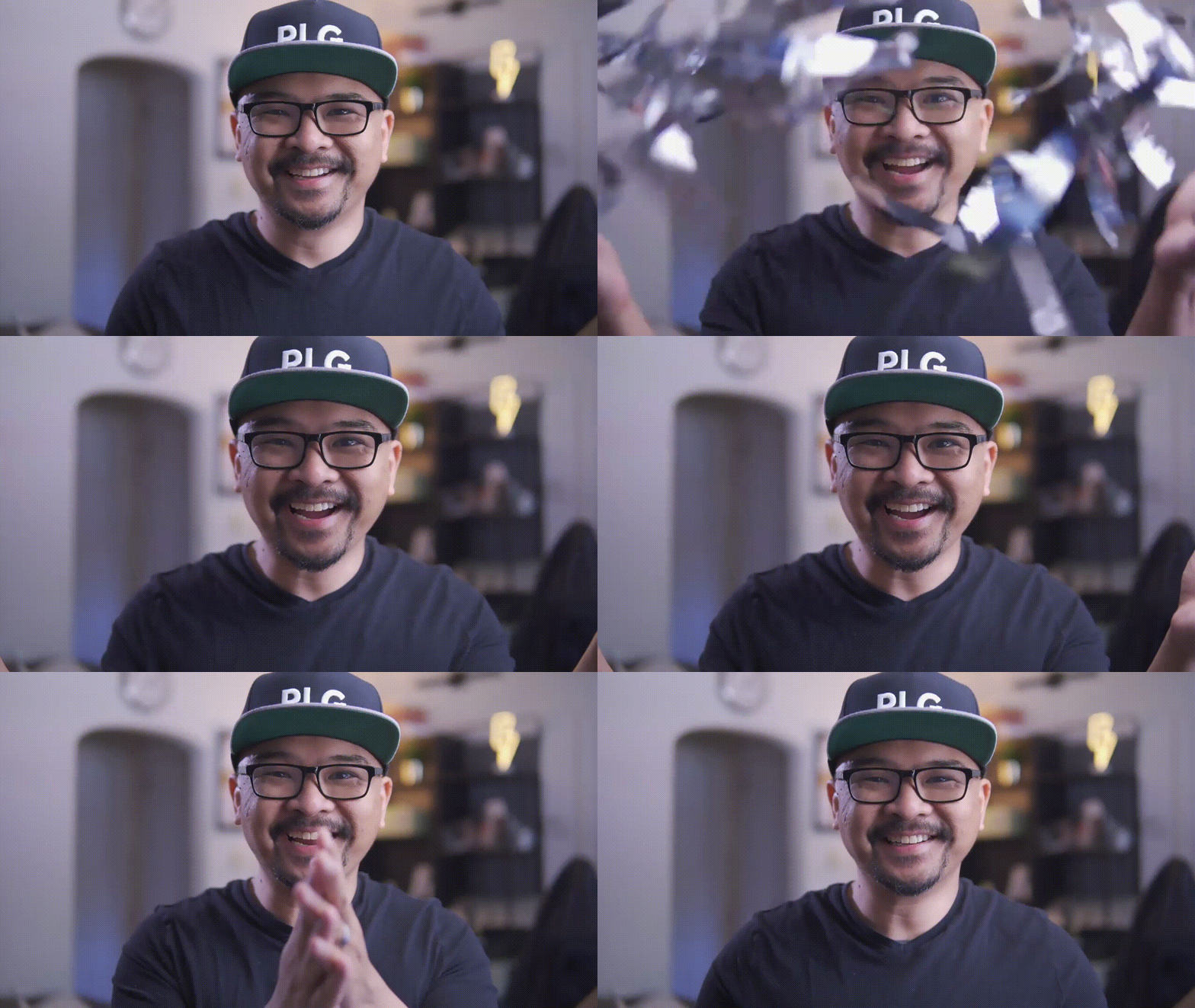
And beyond that, he said something that felt like the thesis of this entire piece, and honestly of the whole reason I keep writing this series:
“What do you truly care about, Ramli? I don’t get asked that often. And I think the answer is connection. That’s at the core of all of it. As long as we have humans in the world, connecting with other humans is one of the most valuable things we can do.”
The nerd from Toronto who wanted to be Einstein, failed at a startup, spent years teaching people in classrooms and conference rooms and Zoom calls how to get closer to the humans they are building for - he has been doing the same thing the whole time. Making people feel less alone. Making the lesson feel real. Earning trust before asking for anything in return.
That is a product philosophy. It is also just a good way to be a person.
You can find Ramli John on LinkedIn and at delightpath.com.
The Product Leaders Lab cohort is open through April 23rd, 2026. Go check it out.
And Ramli - thank you for this, for all of it, and for the confetti every single time.