

There are people in this community who build things for other people. And then there are the ones who build the community itself.
Mike Belsito is the second kind. He is currently the Head of Product Evangelism at Pendo, and was one of the co-founders of Product Collective, and an organizer behind INDUSTRY: The Product Conference. We know this event to be one of the most respected gatherings of product people anywhere in the world. He is, by almost any measure, one of the most consistent contributors to this space over the last decade.
And like my other guests, he will tell you none of it was planned.
He stumbled into product after a startup failure and built a conference out of a lunch conversation and a $0 marketing budget. He has spent years collecting the stories of product people because he believes, at his core, that the thing this community most needs is to feel less alone.
This runs through everything he has ever built. And when you sit down with him and ask him about it, he talks about it the same way he talks about everything else: with warmth, with honesty, and with the kind of self-awareness that only comes from someone who has done a lot of figuring out in public.
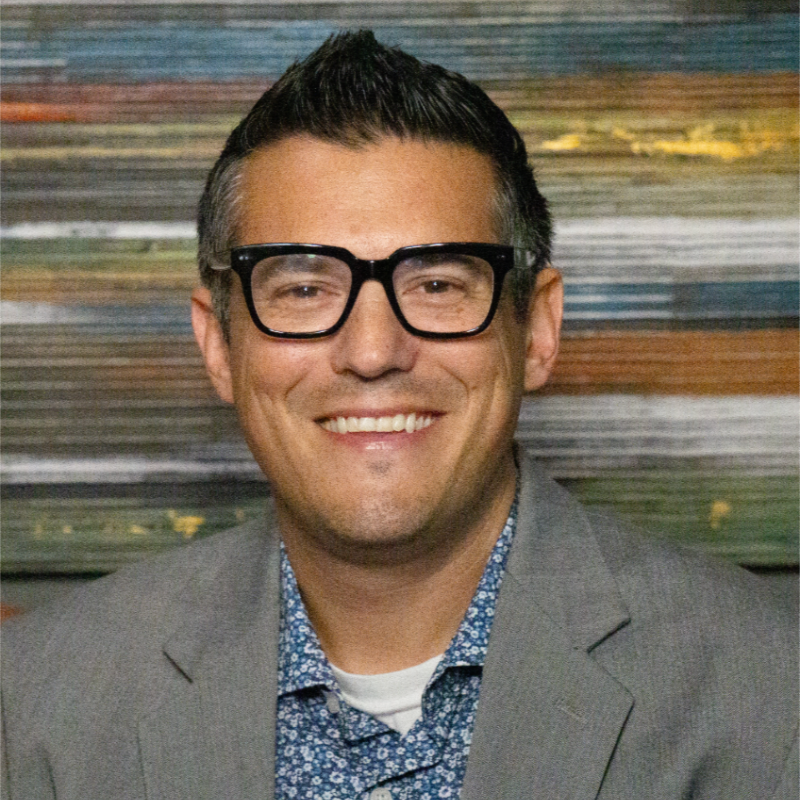
Education and Professional Highlights
Currently: Community Leader and Head of Product Evangelism at Mind the Product and Pendo.
Community: Co-Founder, Product Collective - the unit that served over 30k product management professionals across the globe. Co-Organizer, INDUSTRY: The Product Conference and New York Product Conference. Adjunct Professor, Department of Design and Innovation, Case Western Reserve University. Co-Host, Rocketship.FM podcast.
Before Community: Twelve years across startup companies including Employee Number One at Findaway (later acquired by Spotify). Co-Founder and CEO of eFuneral (acquired by Homesteaders Life Company, 2014).
Book: Forthcoming, February 2027. On the timeless characteristics of product people that help them thrive through massive change: product sense, taste, curiosity, judgment.
Education: MBA, Case Western Reserve University, 2005. BS, Bowling Green State University.
Based in: Cleveland, Ohio.
Named: One of the Top 40 Influencers in Product Management on multiple occasions.
Where He Came From
Mike grew up in Cleveland and came back to it. That is not a small thing in a world where ambition is usually measured by the direction you leave, not the decision to stay.
He graduated from Bowling Green State University, got his MBA at Case Western Reserve in 2005, and then did the thing that felt true to him: he joined a startup. Not because he knew what he was getting into. Because he was drawn to the founders. He wanted to learn what it actually meant to build something from nothing, and the fastest way to do that was to be in the room with people who were doing it.
Findaway was a Cleveland-based company creating digital audiobooks. Mike was employee number one. He stayed for six years, watching the company grow from three people in a room to a two hundred-person operation with twenty million dollars in revenue. He learned by proximity. Every call the founders took, he was there. Every decision, he was watching.
He calls those six years his real business school.
“I was really fascinated with the founders and their backgrounds and thought I could learn a lot from them. That’s what led me to joining Findaway. And once I did, for me it’s like my startup career wasn’t on any sort of path. But the common thread was that the companies I started happened to solve a big pain point I was personally experiencing.”
That pattern, building for a pain you have personally felt, would define everything that came after.
The Company He Built Out of Grief
In the summer of 2010, Mike’s cousin died unexpectedly. His family was put in the position that most families eventually find themselves in: needing to plan a funeral quickly, without any idea where to start or how to evaluate the options in front of them.
His dad was trying to help sort it out and asked Mike if there was something like Angie’s List for funeral homes. Mike told him he was sure there was and went to look. There was nothing.
What his family experienced was not just the grief of losing someone. It was the specific disorientation of being asked to make a significant, expensive, permanent decision without any information to help them make it well. Price, quality, services, reputation. None of it was transparent. They picked a funeral home and hoped for the best.
A year later, Mike launched eFuneral.
The idea was to bring transparency to funeral planning. Not just price comparison, though pricing was a part of it, but the full picture. What services does this funeral home offer? What do other families say about them? What should you actually expect? The goal was to make one of the most difficult moments in a person’s life slightly less disorienting.
They went through several business models and several years of trying to find the one that worked. In 2014, eFuneral was acquired by Homesteaders Life Company, a large life insurance company in the death care space. Mike was invited to stay. He did not.
“The mission was to bring transparency to funeral planning. Homesteaders had their own funeral home clients, so their interest was driving business to those clients. That’s fine. That’s a legitimate thing.
But it wasn’t our mission.
And if it’s not aligned with the mission, it’s just a job. And if it’s just a job, I could work anywhere.”
He left and started figuring out what was next.
How Product Found Him
While eFuneral was still running, Mike had been invited to speak at a local Cleveland event called Tech Pint, a community gathering for the broader tech scene organized by his friend Paul McAvinchey. He was the first speaker at the first Tech Pint. They became friends.
After eFuneral, a company called Veritix came looking for a director of product strategy. They were a ticketing company owned by Dan Gilbert, who also owns Quicken Loans and the Cleveland Cavaliers. They wanted to build a lightweight ticketing platform for high school sports and they wanted Mike to lead the product for it.
He Googled the job title.
He had no idea what a director of product strategy actually did. He told them he was not remotely qualified. They told him nobody went to school for product management, and that his background as a founder was exactly what they were looking for.
Looking back, he can see that he had been doing product work the entire time he was building companies. He just had not known it had a name. The realization was exciting and disorienting in equal measure.
“It felt like being right out of business school again. Like, how does this world work? Because I had to figure out how the best product people actually thrive in their jobs. I knew what entrepreneurs did. But being in this role, it’s like they said we trust you, go figure it out. And so I had to figure it out.”
He read. He listened to podcasts. He talked to other product people. He found out, consistently, that they felt exactly the way he did. Nobody had it fully figured out. They were all constructing their understanding in real time.
That discovery, that the feeling of not quite knowing what you are doing is almost universal among product people, would become the foundation of everything he built next.
The Conference That Started at a Lunch Table
Paul had organized a day-long version of Tech Pint called the Industry Digital Summit. It was a broad tech event, well attended, and well received. When he asked Mike for feedback, Mike told him the truth: there were too many events in Cleveland saying similar things with similar people. What if he went deep on one area instead?
Mike was trying to figure out what it meant to be a product person. There was not much out there for people like him. What if Paul made an event specifically for product, and it just happened to be in Cleveland?
He pointed to a model he had seen work. Content Marketing World was a conference that Joe Pulizzi had built in Cleveland, not for Cleveland content marketers but for content marketers everywhere. The event was in the city but the audience was not local. Mike wondered if the same thing could work for product.
Paul’s response was: you seem passionate about this. What if we did it together?
That first year, fall of 2015, they both still had day jobs. Mike was up from five in the morning to seven, cold-emailing strangers before he went to work. They had no marketing budget to speak of. They had Paul’s Tech Pint mailing list, which was a completely different audience from the one they were trying to build.
Two hundred and fifty people came. From twenty-one states and seven countries. When he said this to me, I could see the pride in his eyes, when he said those numbers out loud. Like the pride one feels when they remember health stats when their baby was born.
“That’s what blew my mind. Because it’s like, what could this have been if we were full time? What could this have been if we had any money? We each put in a little bit and that was the only money we had to work with. But seeing people come from all over, that let me know we were at least on to something.”
By summer of 2016, Mike left his job and went full time into Product Collective. Paul followed shortly after. The community, the newsletter, the second conference, all of it started building from there. INDUSTRY has since run in Cleveland, Dublin, and New York. The community now serves more than thirty thousand product professionals globally.
The thing he is most proud of has nothing to do with the numbers. It is that from the very first year, they decided that speakers would be invited on merit, not on whether they were paying to be there. Some sponsors came and said they would only join if they got a keynote slot. Mike and Paul turned the money down.
It cost them. And they did not regret it.
Everything Is a Product
Mike’s wife Hannah is the Chief Experience Officer at Destination Cleveland, the city’s convention and visitors bureau. Her job is to bring business travelers and leisure travelers to Cleveland and to shape the experience of being there.
She came to one of the early editions of INDUSTRY to see what her husband had quit his job to build. When she left, she told him something that has stayed with him ever since.
She said: “I think I am kind of a product person too. Cleveland is my product.”
“When she said that, I realized everything is a product if you really think about it. And I learned a lot from watching how she positions Cleveland as a product. She’s thinking about the customer. She’s thinking about the experience. The things she’s doing are relevant to how I might serve people within our community too.”
This is the center of Mike’s view on the craft. Us tech product people get lost in our own bubble. We read the same newsletters, follow the same accounts, attend the same conferences, and gradually lose the thread back to the actual humans we are supposed to be serving. Getting out of that bubble, spending time with people who build things in completely different contexts, is not a nice-to-have. It is how you stay calibrated to what problems actually feel like.
The Chick-fil-A example he tells from an early INDUSTRY conference makes the same point. A woman approached him after a talk and told him she worked at the fast-food company. When you walk into Chick-fil-A, she said, that is my product. There are teams of people thinking about every part of that experience. She came to INDUSTRY to bring learnings from the software world back to what she was building. And Mike came away with something too.
Empathy, curiosity, problem-finding. These things do not belong to tech. They belong to anyone building something that other people have to live inside.
What He Is Seeing Right Now
Mike just came back from Australia, where he spoke at the Leading the Product conference. He was struck by how similar the conversations felt to the ones he has in Cleveland and Rochester and every other place he goes. Not the Bay Area conversations, where the assumption is that everyone has fully adopted AI and is now managing agents that manage other agents. The real conversations.
He asked a room of product people to write down the one thing they were most excited about and the one thing keeping them up at night. For most of them, it was the same answer for both.
The pace of change. Exciting and terrifying in the same breath.
He has a friend who has been an engineer at a Fortune 10 company for twenty years. Six months ago, that friend asked Mike if he thought AI was a fad. Mike told him no. But the fact that the question was being asked told him everything he needed to know about where most of the world actually sits right now.
“Not everybody is all pilled in and doing all the things. And I think that is important to realize because sometimes people feel exhausted and like they’re completely behind and everybody’s ahead of them. That’s not the case. Most of the tech world is actually where you’re at. It’s not what we read about all the time.”
He thinks the product people who thrive in this moment will be the ones who adopt a beginner’s mindset again. Not because they have to pretend they do not know things, but because the willingness to not know, to stay curious, to be comfortable with uncertainty, is precisely the quality that will separate the people who grow through this from the ones who get left behind.
He remembers what it felt like to be new to product. The naivety, the curiosity, the reading everything he could find because he genuinely did not know where to start. He says that feeling is not a weakness. It is the thing.
“AI will help us automate away the mechanics of product work. The 80% that isn’t really the reason we got into this. What’s left is product sense, taste, judgment, curiosity. The things that probably attracted us to this role in the first place. My hope is that this frees us up to actually do more of the real product work.”
The Book
Mike is finishing the first draft of a book. It was not on his radar a year ago. He would tell you that plainly.
The book is about the timeless characteristics of product people that help them thrive through periods of massive change. Product sense. Taste. Curiosity. Judgment. Things that have always mattered, that now matter even more, and that most books on the subject treat as either innate or unteachable.
He disagrees. The book is about how to actually get better at these things. How do you practice product sense? What does it mean to develop your taste deliberately? What does curiosity look like as a discipline rather than a personality trait?
Expected: February 2027.
He built a community because he was a confused product person looking for one. He is writing this book for the same reason. Because he is still in it, still figuring it out, and still believes that the most useful thing he can do is be honest about that and share what he is learning with everyone else who is doing the same.
The People Who Changed Everything
Mike named the founders of Findaway as the people who shaped him most. He still keeps in touch with all three: Christopher Celeste, Blake Squires, and Mitch Kroll. He still looks up to them as mentors. They were his real business school, he said, in a way that the MBA simply was not.
He named Paul McAvinchey, his co-founder at Product Collective, as someone without whom none of the community work would exist. They started something together with nothing and built it into something real.
He named Bryan Chaikin, his co-founder at eFuneral, and Kurt Pettit, his partner on an earlier side project called Appstand. He said something about co-founders that I want to share here, because it is true and not said often enough.
“Starting things can be a lonely process. The ups are very high and the downs can be very low, and sometimes you feel them both in the same day. Having somebody who is there with you the whole time makes a big difference.”
And he named his wife, Hannah. He said that having someone at home who is supportive, who is successful in her own right, who understands what it means to build something, made it possible for him to do what he did. He could not imagine going through it without that.
Is It Okay to Not Know What You Are Doing?
I always end with this question. What do you wish someone would just ask you that nobody ever does?
Mike thought about it. Then he said something I had not heard before.
He said the question he wishes someone would ask product people, in interviews and in conversations and in all the places where we perform our competence, is this: “Is it okay to not know what I am doing?”
“We are hired for what we know. We are hired because we are smart people who have done cool things. And so there’s this pressure to have all the answers. But that’s how I felt early on in product. And I think that’s going to be really important for people to adopt that mindset now, with things changing so much. Is it okay to not know? Because I think the answer is yes.
And I think people need to hear that.”
He built a conference because he was looking for a community. He built a community because he was a confused product person who did not want other confused product people to feel alone. He is writing a book about the qualities that make product people good at their work, not because he has them mastered, but because he thinks they can be practiced and he wants to show other people how.
Everything he has built has been for the version of himself who needed it first. And having one of the truest product hearts I’ve seen, Mike shares because he knows how to help solve pain and need in our community.
You can find Mike at MikeBelsito.com and on LinkedIn. You can also see him in person at Pendo and Mind the Product’s various community events and conferences throughout the world. His book will be published by Wiley and is expected to be released in February of 2027.
Go find him before then and tell him Christine sent you.