I met Debbie McMahon in London at a Product School conference, and within about ten minutes talking to her backstage I was a fan. When she got on stage I immediately saw there was something about the way she holds a room without trying to hold it. She is direct without being sharp, honest without being unkind, and funny in that particular way where you are not entirely sure whether to laugh or take notes.
When I asked her to be a part of this series and she said yes, something told me it would be a real real one. The conversation we had felt less like an interview and more like catching up with a friend I had been meaning to call.

Debbie is currently VP of Product at loveholidays, a UK-based online travel company. Before that she was interim CPO at the Financial Times, and before that Product Director for FT.com and apps. Before all of that she was at the BBC, and before the BBC she was in the UK civil service for nearly a decade, building things for the people who needed them most.
That last part is where her story really starts. And it is, I think, the most interesting part of who she is.
Education and Professional Highlights
Currently: VP of Product at loveholidays, a UK-based online travel company.
Before that: Interim CPO at the Financial Times (2024 to 2025). Product Director, FT.com and apps (2021 to 2024). Head of Product, BBC Account (2020 to 2021).
Before tech: Nearly a decade at the UK Department for Work and Pensions. Head of Product Strategy, Universal Credit (2016 to 2019). Head of Service Design, Universal Credit (2015 to 2016). Jobcentre District Manager, Essex (2012 to 2014). Private Secretary to the Minister for Employment (2009 to 2012).
Education: BSc Hons Mathematics, University of Glasgow.
Grew up in: Ayr, Scotland. Population 40,000. No product managers to be seen ;)
Known for: Outcome-focused leadership, calling it out when something needs to be called out, and the ability to spot potential in a person before they can see it themselves.
Where She Came From
Debbie grew up in Ayr, a small town on the west coast of Scotland. Forty thousand people. Both her parents were teachers, her father a head teacher, her mother an assistant head, and neither of them moved around much. Her dad worked at one school for his entire career and got promoted up through it. The idea that their daughter would end up as a VP at a consumer tech company in London, having spent a decade building digital products at some of the UK’s most recognizable institutions, would have likely been unimaginable.
She said this herself, with the particular kind of warmth that comes from people who have traveled a long way from where they started and still feel the distance.
“Product was just not a thing in Ayr. There was no product there. There was no product in Glasgow when I went to university. I couldn’t possibly have imagined any of this.”
She studied mathematics at the University of Glasgow. When it came to figuring out what to do next, she knew a few things: she did not want a traditional profession, she did not want to pick one specific thing, and she grew up in an environment where stability was what you aimed for. The civil service, which offered the chance to do many different things without locking her into a single track, made sense. So that is where she went.
She has been figuring out what is next ever since. And every time she has figured it out, it has been bigger than the time before.
What the Civil Service Actually Gave Her
I asked Debbie what the civil service gave her that a more traditional tech path might not have. Her first answer was perspective, and she gave a very specific version of it.
She said that even the worst thing that could happen in a product organization, a budget overrun, a launch that goes badly, a quarter that misses, feels different when you have previously worked in an environment where a staff member getting punched in the face was not an unusual occurrence. Where the stakes of a bad day were not retention metrics but whether someone could put food on the table.
She was not dismissive of the stakes in tech. She was clear that she does not use this to minimize what goes wrong. But she said it does give her the ability, even in her hardest moments, to ground herself in the fact that the problem is solvable and that she has dealt with worse.
Her second answer was about management. She led her first team at twenty-three. By the time she got to tech she had managed large teams in genuinely complex human situations, people navigating circumstances she had never personally experienced, and had learned early that when you have a team of that size, delegation is not a philosophy. It is a survival mechanism.
“I have never found delegation all that difficult because relatively early in my career I had a huge team. You cannot do the jobs of eighty or ninety people. It is impossible. So you have to learn to let go. But then have empathy with the individual when that is the right thing.”
She said something else about management. I think it is the thing she most wanted to say. She is watching the current wave of flattening and de-layering in tech and she recognizes it from previous waves. She sees people being promoted to VP earlier today, before they have ever bought a car, then having someone come to them with a cancer diagnosis, and not knowing what to do. She is not against leaner structures. But she believes, with real conviction, that humans motivating humans and having empathy with humans in a way that makes a company more than the sum of its parts is something that stripping out management cannot replicate.
“I think these skills come from a background where it was so important to understand the humans because that was the only lever you had.
I didn’t have millions of pounds. I just had people.”
The People Who Made a Difference
When I asked Debbie who modeled a way of thinking she still recognizes in herself, she first named a former boss, JP, from her civil service years.
She worked for JP three times across different roles in the same organization. She said she only understood what she was learning from him many years after the fact. He made a specific, deliberate choice: he traded junior headcount for senior leadership, believing that investing in the quality of leadership, even at a short-term cost to worker capacity, would produce a better workforce, better outcomes, and ultimately better results for the people those teams served.
He did it in multiple organizations. The people who followed him tended to carry the lesson even when the structure eventually unwound. Debbie was one of them.
“He was willing to put himself on the line to make it happen. He didn’t go to his boss and say he needed extra money. He said I can make this happen in my own environment. I can make these choices and I can achieve the thing I’m standing by.”
That combination, the belief in the power of leadership and the willingness to stake your own position on it, is something she has carried into every role since.
She also shared thanks for another human, JK, with a beautiful and simple why: He reminded her many times that our lives actually don’t go in a nice straight path and our dreams can take many forms and must be our own, and no-one else’s.
And finally, there is Lara Sampson. She was the first woman Debbie worked for in tech, and she described her with a specific kind of warmth that I recognized immediately - the warmth you reserve for someone who made something feel possible that you were not sure was possible for you.
Lara was juggling children and a demanding job and working part-time, and doing all of it with a quality of thinking that Debbie said she has rarely seen matched. But what she kept coming back to was not the accomplishment. It was the accessibility of it. Lara was not someone who made you feel like you were watching a performance you could never replicate. She was someone who made you feel like you could get there too, if you paid attention and kept going.
“She was an accessible version of amazing. You knew she wasn’t amazing at everything. But she totally knew how to mitigate those things and hire people around her. I just learned so much from her. I wouldn’t work in product if it wasn’t for Lara.”
Not the most famous name. Not the biggest platform. The woman who made the path feel navigable when it might otherwise have felt closed. That is the kind of thanks that means something.
Fifty Million Users, a Pandemic, and a Product That Went Down
Debbie joined the BBC as Head of Product for BBC Account in 2020. She had been there for eight weeks total when the pandemic hit. She went on holiday for one week. She came back on a Monday.
That Monday evening, the UK went into lockdown. The entire country tried to get onto iPlayer at the same time. BBC Account was the gateway. Her product went down.
She told me this with the particular tone of someone who has processed the memory thoroughly and emerged with a very specific lesson:
“If you work on a high-scale product, know your infrastructure before anything else happens.”
But the deeper thing she took from the BBC was about value. At a commercial company, she said, you can attach value to a price. Someone pays four ninety-nine a month and you can build a list of what that buys them and ask whether the exchange feels fair. At the BBC, that mechanism did not exist. What she discovered was that people could articulate the value the BBC brought to their lives with remarkable clarity when asked, even without a price tag anchoring the conversation. The research the BBC had done, actually removing the service temporarily from sample groups to understand what they would miss, produced results that surprised her.
“People were able to articulate much more clearly than I had ever anticipated what value the BBC was bringing to them. But the organization found it difficult to cut through the noise to communicate that back.”
The metric she kept coming back to was something the BBC had developed internally around habit and multi-modal engagement. If a user came to the BBC for a certain number of hours across a certain number of days through at least two different modes, whether that was web, TV, radio, or app, and they were logged in and getting a personalized experience, they renewed their license fee. They kept paying because the value had become tangible rather than assumed.
She still references that framework. At loveholidays now, she said, they are asking what it means to describe something as a good value holiday. Not the cheapest. The best value for whatever you spent. That is a hard question to get to the heart of, and the BBC taught her that the way to get there is not to assume you know the answer. It is to ask.
Operating Inside the Bubble
The Financial Times is subscription-driven, journalist-forward, and very clear about what it is and what it is not. I asked her what the hardest thing was about building product inside a world-class editorial organization. Her answer was not what I expected.
She said the hardest thing was not the journalists. It was learning to know your bubble.
She gave a very clear example. If her team went out and did thorough research and discovered that millions more people would read the FT if it had a celebrity gossip column, that was a useless piece of information. Because that was never going to happen. The editorial strategy was the container within which she could operate, and the sooner she understood the shape of that container and started working powerfully inside it rather than fighting its edges, the more effective she became.
“The parameters in which I operate are around me almost like a bubble. The editorial strategy. I can only operate within that. I can push the boundaries of it and figure out how to best utilize it. But I still have to operate within it. Otherwise, I’m essentially useless.”
She talked about finding the people inside the organization who were also up for pushing the boundaries within the container. Working with one of the heads of newsletters, for example, who was genuinely curious about experimentation. Testing something in a space where the door was open, and then using that evidence to explore somewhere else.
I asked her whether that felt relevant to the AI moment we are all in now, where everyone is being told to move fast and ship AI features and the customers are still just trying to get through their day. She lit up.
She chuckled somewhat, and told me she is giving a talk the next day called the AI Adoption Gap. Her central argument: the product community is living in a bubble, talking about AI every minute of every day, and has almost entirely lost the thread back to the humans outside that bubble who are just trying to get on with their lives.
Hallelujah!
She used WhatsApp’s Meta AI integration as her example. The top suggested prompt when she opened it to check was parenting advice. She is not a parent. She did not ask for the feature. Nobody asked her if she wanted it. Mind you, she loves WhatsApp but this experience was not one someone like us would find delightful. Many of us would do well to think about this for a moment today, and ask whether we’re still focused on that customer who brought us success in the first place.
“We’re shoving things at our customers that none of them asked for.
We’ve forgotten it’s our job to bridge the gap and solve the actual problem they have.
Not just make up a new problem.”
This is the thread running through everything Debbie has built: who is this actually for, and are we still talking to them?
What She Was Looking For Next
When Debbie started thinking about what came after the FT, she was very clear about what she wanted. Smaller. Faster. A company that knew where it was going. And she wanted to be the only one.
That last one took me a second to understand. She explained it with a bluntness I have come to appreciate in our field: she was tired of negotiating across a peer group as well as up and down and across the rest of the organization. She wanted to drive the product strategy without the horizontal politics that come with being one of several people who each own a piece.
Loveholidays, a PE-owned UK online travel company of fewer than five hundred people, gave her all of that. She is VP of Product. She is one of one, as she says.
One of the first things she built there, shepherding it closely because it mattered to her, was the company’s own customer review system. Loveholidays became the first UK-based online travel agent to host its own customer reviews on site for hotels. She had a product manager on her team who believed in it before the rest of the company did. She backed them, spent six months aligning the organization, navigated the compliance questions, and watched the product manager grow through the complexity of getting it across the line.
Two weeks before we spoke, they had launched in Scandinavia. Customer service called some of the first customers who had booked in a brand new market to ask why they had chosen loveholidays. One of the first people they reached, a customer from Norway, said: because you had your own reviews and I read them and they convinced me.
“This is what I do this job for. This is my joy.”
Using the Privilege You Did Not Ask For
Debbie has spoken publicly about being the only woman in rooms and choosing to call out behavior that makes women uncomfortable, not just for herself but for the junior women who do not yet feel they have the weight to do it.
I asked her what pushed her to advocate so fiercely. Her answer was disarmingly honest.
She laid out her own privilege for me. She is a white middle-class woman in tech with no disabilities, no health conditions, and no children. She is clear that she is in the room partly because of that privilege, not despite it. And she said that the only thing she can do with the privilege of being there is use it, because there are many other talented women who have had a harder time getting to the same place.
“I need to use it because otherwise, what’s the point of me?”
I told her, as a brown woman with children who has fought for seats, sometimes bringing my own chair, and then realizing some tables were not worth fighting to be a part of, that I appreciated her for doing it. She heard me.
To any woman who can identify with Debbie’s position, and uses that to advocate - not to be performative - for the drowned out voices, we appreciate you.
When I asked her about her advice to women in tech, she was equally direct about what she was not saying. She was not telling anyone to lean in or act like a man or pretend the system is designed for them. She knows it is not.
What she was saying is that she has watched women spend enormous amounts of energy looking backward and inward, measuring themselves against where they should have been by now, rather than looking forward at where they actually want to go. And she thinks that shift, even partial, even imperfect, is the thing with the most practical impact.
“You are here now. And the more time you spend looking forward, the more chance you have of getting to that place. And then probably from there the next place will be easier, and then the next, and it compounds.”
There is no magic in this advice. She said so herself. But it is sound, and she said it with the particular authority of someone who went from a job center in Essex to a CPO seat at the Financial Times and still wakes up slightly amazed at where she ended up.
The Thread You Pull That Changes Everything
Nina was working at a job center in Harlow, Essex. She was a team lead, a couple of levels below Debbie in the organization. She was smart, switched on, and doing work that was not close to the ceiling of what she was capable of.
In one of their early one-on-ones, Debbie looked at her and asked a question that must have felt very strange to receive: what are you doing here?
Not an accusation. A genuine question born of recognition - a Debbie question. Someone with this much going for her, still here, still in this particular box. What was keeping her there?
This was 2012, roughly fifteen years ago.
A job came around for a subject matter expert role on Universal Credit. Debbie saw it and knew immediately. Nina came around the corner at that exact moment, on her way to ask whether she could apply. Debbie said yes before she finished the question. Nina moved from subject matter expert to business analyst to product manager, was eventually promoted to lead PM, and two years later, after Debbie had already moved to the Financial Times, Debbie had the same conversation with her again: why are you still in government? You have a profession now. Come and try somewhere else.
Nina was very far in her professional career in years, and concerned time was not on her side.
Debbie, characteristically, told her to stop it.
Nina came to the FT. She is now a Group Manager there, working with journalists on content products.
“I pulled a thread that resulted in so many things being different for her than they possibly would have been. And what it reminds me of is that you can have a huge impact on an individual person. I didn’t make her apply for that job. I didn’t get her the job. But I pulled a thread.”
She paused. And then she said something that she didn’t know I needed to hear right now.
Nobody is too old. Nina had thirty years in the civil service when she was fifty. She took a risk anyway. The worst that happens in almost all cases is not as bad as we build it up to be inside our heads. The boxes we put ourselves in are almost always smaller than the life that is available on the other side of them.
What Nobody Tells You About the CPO Seat
I asked Debbie what surprised her most about making the jump from Product Director to CPO. She did not hesitate.
She said she genuinely believed she was about to run one enormous delivery unit. She had been running a large piece of the FT’s consumer product and now she would get to run all of it. She was excited.
What she discovered was that she was not running one big delivery unit. She was running five separate ones, and the tools she had used to manage a single delivery unit, moving people around, rebalancing outcomes, responding quickly to what was working and what was not, were simply not available at the CPO level in the same way.
“The levers I used to have within one delivery unit to go, okay, this bit is not going so well, I can move people around and swap some outcomes around. At the CPO level, you can’t do that. Because the organization has spent months negotiating how the investment is structured. You cannot just come in and move ten people from here to there.”
The second thing she named was the team. At CPO level, she said, your home team - or as some of us know it as, ‘first team’ - has to be your cross-functional peers. Not the product organization. The whole leadership table. Because if every person around that table is only fighting for their own area, the company goes nowhere. And the moment you walk into that room, you have to be able to ask what is good for the whole company right now, even if the answer genuinely annoys every product person in the building.
What She Wishes Someone Would Ask
I always end with this question. What do you wish someone would just ask you that nobody ever does?
Debbie thought about it for a moment. I wanted to honor her honesty without overreaching into territory she shared in the spirit of thinking out loud.
She said that whenever anyone asks how she is, the answer is always fine. And that after a while, you forget what the real answer would even be. She mentioned this quietly - that there are hard things happening outside of work, the kind that do not belong in a team meeting or a board update, and that the performance of being okay is so well practiced that the authentic answer and the question almost stop connecting.
Debbie also shared that she thinks women in the workplace, in particular, need spaces where that question gets asked and answered honestly. Not in the team meeting. Not in the board update. In the smaller, safer spaces that are harder to find when you are often the only woman in the room.
She did not say this as a complaint. She said it as an observation from someone who has spent a long time in rooms that were not designed with her in mind, finding ways to do extraordinary work inside them anyway.
That is, in the end, the story of Debbie McMahon. Not the trajectory, though the trajectory is remarkable. The way she moves through every environment she enters: clear-eyed about its constraints, curious about what is possible within them, and always, always paying attention to the humans.
Even, and maybe especially, the ones nobody else has noticed yet.
You can find Debbie on LinkedIn. She is giving talks, building things at loveholidays, and probably already thinking three moves ahead.
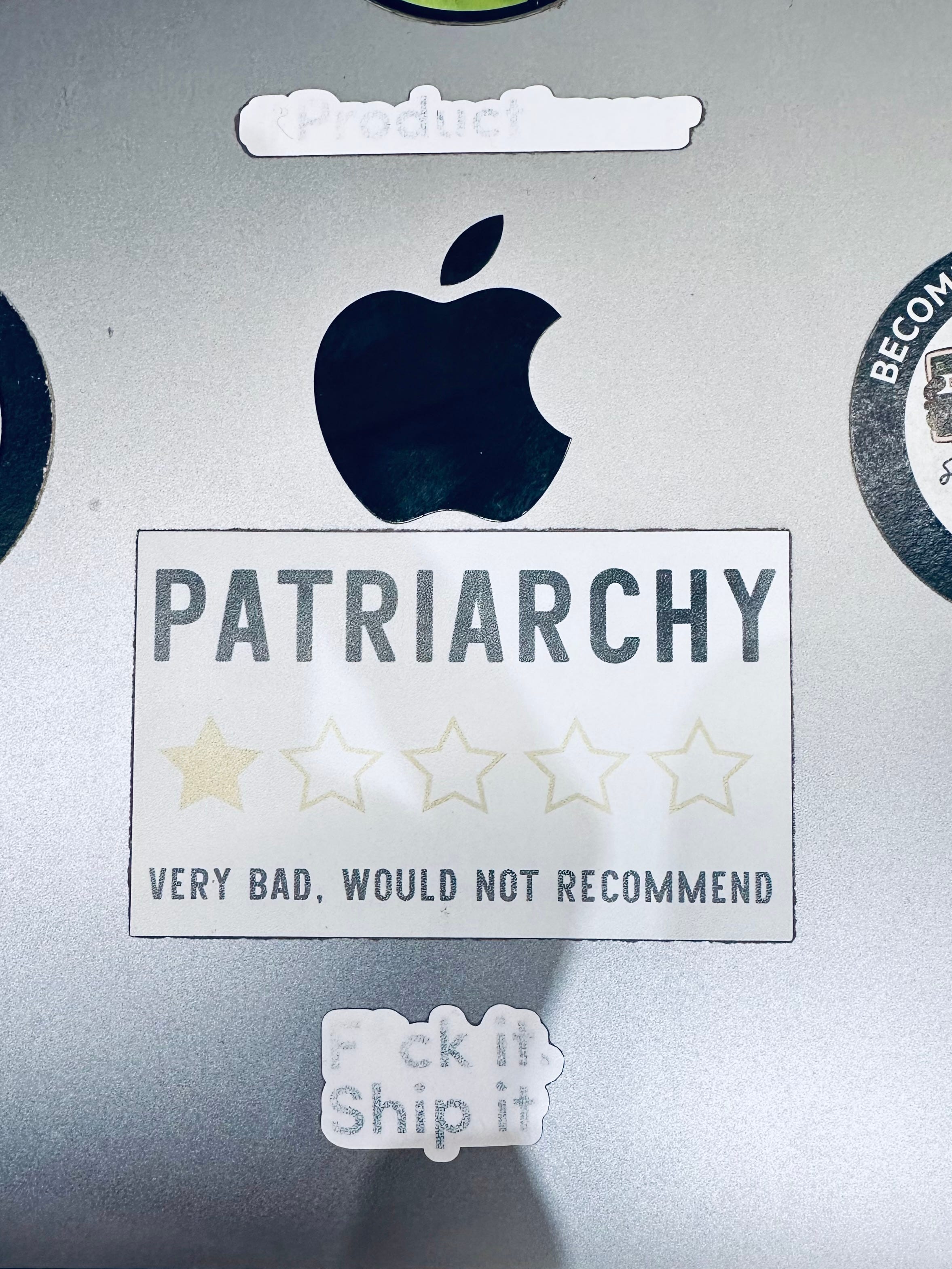
Debbie, thank you. London feels like a long time ago now. I’m glad I was smart enough to know that day you are in fact, a real one. I am also very happy I snuck and took this photo of your laptop cover backstage - thanks for letting me share here :)