

I met Dave Masters back in my Pendo days, which feels like a lifetime ago and also somehow like last week. That is the thing about the people you meet when you’re doing work you genuinely love - they stick. He was one of those people: sharp, warm, low ego, and deeply invested in the craft, the kind of product person you want in the room when things get hard.
We reconnected recently and I’m so glad we did, because Dave is exactly the kind of person this series exists for. We talked the way you talk with someone who genuinely loves the craft and has been in it long enough to have real things to say about where it’s been and where it’s going, and that conversation led to this one.
Dave spent over two decades shaping digital products, most recently as a Senior Director of Product at Realtor.com, where he led teams building experiences across the full home buying and selling lifecycle. He’s mentored product managers, built through digital transformation, and has the kind of quiet intellectual credibility that comes from doing the work for a long time rather than just talking about it.
He’s now consulting, building his own things, and moving at a pace he hasn’t experienced in years, in the best possible way.
This one is for the practitioners.
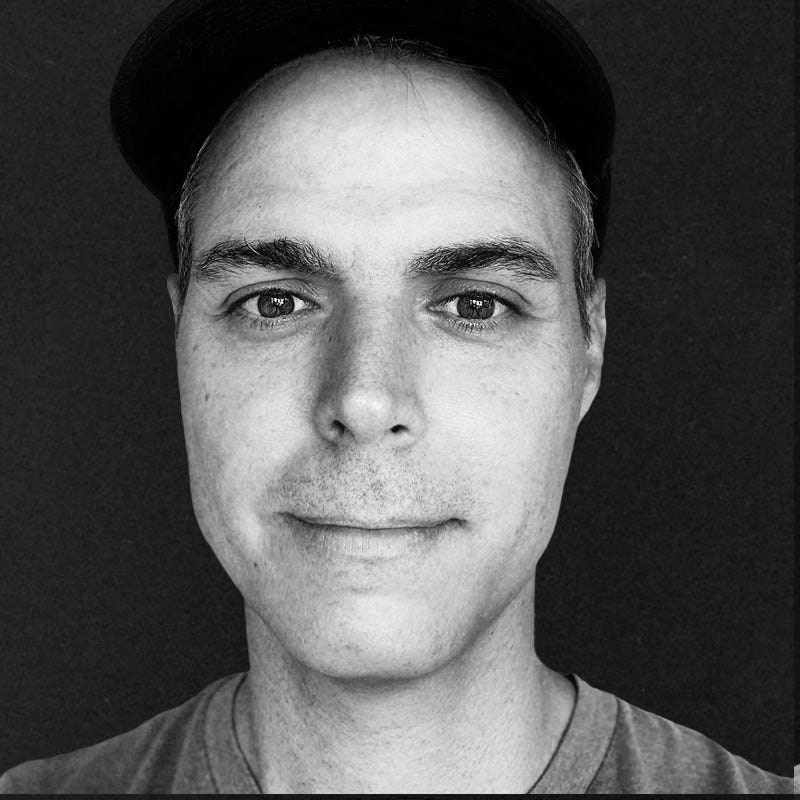
Education and Professional Highlights
Most recently: Senior Director of Product, Realtor.com - 20+ years across consumer products, internal tooling, marketplace businesses, and customer-facing platforms.
Based in: Greater New York City Area
Originally from: Phoenix, Arizona
Education: Non-traditional - moved out on his own before finishing high school, started working at 17, community college part time. No four-year degree. Twenty-plus years of results instead.
Career arc: Account management, customer retention, business systems analyst, internal tooling, consumer product, Senior Director at Realtor.com, and now consulting independently.
Where He Came From
Dave grew up in Arizona skateboarding and playing in bands, and I want to stay here for a minute because I think it’s actually the whole thing, not just a fun detail.
Skateboarders see the world differently - a bench isn’t a bench, it’s an obstacle, an opportunity, a thing to figure out. Dave’s son skates now too, and Dave described them walking around together and his son pointing at a ledge the way another kid might point at a candy store. That instinct, to look at the built environment and ask what else it could be, isn’t just a skate park habit. It’s a design instinct, and it’s a product instinct.
And then there’s the DIY ethic that comes from years in independent music. You do things yourself because you believe in them, not because someone gave you permission or a budget, and the second a major label gets involved, he said, layers multiply and things start to fall apart. You can see why someone who grew up in that world would spend a career allergic to bureaucracy and addicted to the feeling of actually shipping things.“DIY community is just ingrained in me from a pretty young age.”
Both of those things - the skater’s reframe and the indie musician’s self-reliance - show up constantly in how Dave approaches product. He’s not the person waiting for someone to tell him what’s possible. He’s the person already building the prototype.
The Person Who Shaped Him
Dave isn’t someone who points to a single mentor and says, this person made me - he’s more honest than that. When I asked about someone who shaped his way of thinking before his career existed, he went quiet for a second, and then he talked about his mom.
His mom held so much together for her children following divorce, and in general as a rock for him. Dave remembers now, as an adult, understanding what she actually sacrificed during those years - she’d have two dollars to her name and split it three ways between her kids without a second thought. She wasn’t eating lunch. They were.
“I think that shaped me in more ways than I recognized at the time.”
Selflessness, resilience under real adversity, showing up for the people who depend on you even when there isn’t much left to give - you can see all of that in how Dave talks about the teams he’s led and the leaders he’s most admired over the years.
How Product Found Him
Dave’s path into product is the kind of story that gets harder to have as the years go by. He was seventeen, out on his own, paying bills, and doing community college part time when he could. A friend who worked at a tech company at the start of the dot-com era needed referrals to earn a bonus before Christmas and pulled Dave in, and he came in through account management and customer retention before something clicked.
They needed someone to help shepherd an order-to-cash system they were building, to stand between the people building it and the people using it and make sure both sides were understood by the other. Dave stepped in, his title became Business Systems Analyst, and he didn’t know it at the time, but that was product.
“It wasn’t called that then. But that’s sort of how I got there.”
From internal tooling he moved toward customer support systems, then consumer-facing products, and eventually into leadership at one of the largest real estate platforms in the country. None of it was planned, and all of it was earned by showing up curious and staying close to the problem.
He made a point worth underlining: universities are now teaching product management, and that’s good. But the frameworks a curriculum can teach you don’t replace what happens when you sit in front of a real person and watch them struggle with something they shouldn’t be struggling with. That education doesn’t live in a textbook.
“Until you actually sit in front of somebody and ask if they’re willing to pay for it, it’s a very different thing.”
He also referenced a piece by Daniel Schmidt he’s returned to for over a decade - The Product Management Triangle - a framework that maps the three core vertices of product work: technology, users, and business. His point was that no two PMs are built the same, and understanding where your team’s strengths and gaps live across that triangle is what tells you where you need to flex, where you need to hire, and where you’re likely to struggle. It’s a dense read, he warned, but one of those pieces that rewards the people who care about the craft seriously enough to sit with it.
Product Is a Way of Life
I asked Dave whether the way he thinks at work ever bleeds into the rest of his life, and he had a very specific answer that happened recently.
His twin brother works in construction with no tech background, but texted him recently: I keep hearing about this AI thing and I think there are ways it could help me, I just don’t know where to start.
Dave got on a call with him, listened, and asked the kind of questions you ask when you’re trying to find the real problem underneath the stated one. His brother talked about communication issues, tracking issues, coordination problems, and by the end of that day Dave had built three working prototypes - one for each core pain point - using Claude. Not polished, not production-ready, but real enough to get feedback fast. “I was basically doing one-on-one product building for my brother. He’s not saying he wants a dashboard. He’s saying this is the problem. Okay - let’s figure out how we’re going to solve that.”
That is the product mindset in its purest form: listen for the actual problem, strip out the feature request, and move toward a solution fast enough to learn something real.
He also talked about how he organizes his day and his life the same way he organizes a roadmap - elevate to the highest level first, ask what you’re actually trying to do and which direction you’re going, then break down the tasks that ladder into that. It sounds simple and it’s not easy to live.“That is for everything. That’s how I kind of operate day to day.”
On AI - The Honest Framework
Dave is doing some of his most interesting thinking right now on how teams should relate to AI during product development, particularly around expectations and pace.
He described a maturity model he has been working on for a while - one that we fully align on - a framework that maps product zones to the right level of speed and deliberateness. On one end, net new greenfield work: move fast, no regrets, just learning and iteration. On the other end, the core product touching the features your most loyal customers depend on: slow, intentional, deliberate.
“When we say we’re going to touch feature X and feature X is a critical part of the core product - slow. Intentional. Don’t expect the same pace that we were able to spin up a prototype for something brand new.”
This matters because one of the new problems AI has created is a leadership expectation mismatch - executives see what’s possible in a sandbox and project that velocity onto the real product with real users and real stakes. Resetting that expectation is now part of the product leader’s job.
He was equally clear about where AI has genuinely helped. Storytelling, show versus tell, the ability to take an idea and make it visible to another human being - that’s never been faster, which means alignment happens faster.
“The ability to come up with an idea and just show someone what you’re talking about has never been faster.”
He also noticed something quietly important about himself: he was moving so fast, thinking fast, building fast, that the slow thinking wasn’t happening - the deliberate strategy work, the stepping back. So he asked Claude to help him figure out how to pace himself better. He was using AI not just as a builder but as a thinking partner for his own cognition, and that is the version of this technology worth believing in.
On the noise problem: every day there’s a new tool, a new paradigm, a new announcement telling you the future arrived this morning, and nobody can keep up with it sustainably. Trying to is its own kind of trap.“It’s less about the adoption curve and more about the right tool for the right job.”
What Product Managers Should Actually Be Measuring
When I asked Dave about metrics, his answer was almost deceptively simple: the core metrics shouldn’t change.
You’re anchoring toward a problem you want to solve, and the question is whether you’re solving it and whether the evidence you’re collecting actually tells you that. Operational metrics - how fast you’re shipping, how many features you’re releasing - are signals, not answers.
“Problem. Proof that we’re on the right path to solving that problem in the most effective way. That mindset shouldn’t change.”
What concerns him is the moment that mindset starts to blur, when teams start measuring AI feature delivery rather than the outcomes those features are driving, when shipping becomes the metric instead of the thing that happens because of what you shipped. We’ve seen this before. It’s just wearing a new outfit.
What the Space Needs Right Now
Dave’s answer was direct: if you’re not already using AI to help draft, think, and prototype, you’re behind. That is the floor, not the ceiling.
The ceiling is something more interesting - staying curious enough to keep growing, humble enough to recognize when someone else’s idea is better, and grounded enough to know what problem you’re actually trying to solve.
He told a story about a thirteen-year-old at a camping trip who built a YouTube replica for indie animation because that’s what he was passionate about - no CS background, no systems knowledge, just tools, curiosity, and a problem he cared about.“My ten-year-old could build something now. That’s really telling.”
His advice is not to panic about that but to use it as a signal. The next generation isn’t waiting for permission to build, and the question is whether you’re investing in the parts of your craft that can’t be automated: judgment, taste, empathy, and the ability to stay close to the real problem underneath the stated one.
“Stay curious. Stay close to the problem. And realize that your idea is not always going to be the best one, even though you may think it is.”
The People Who Changed Everything
Dave is not someone who pretends his success was solo. Let’s get right into it.
His friend Mark Lacy was a salesperson with the best attitude Dave had ever encountered, someone who stayed himself regardless of how stiff the corporate environment got and helped Dave believe in himself early, which matters more than most people give it credit for.
Todd Callow is a general manager type, not a product person, and Dave credits him with something product mentors alone couldn’t give: a clear view into what executives actually care about, and a model for what it looks like to lead people with genuine transparency and care. Dave described him as the most human people leader he’s ever had, and he said if he could make the people on his team feel the way he felt working for Todd, he’d know he was doing it right. I think Todd is my favorite on this list.
Tracey Mahnken ran the business systems analyst group in Dave’s early days and would print out big documents, take out a red pen, and cover them in questions - this was pre-Google Docs. She was teaching him to think in systems, not individual interfaces or isolated components, but the entire chain of cause and effect, and Dave said she’d laugh if she knew he still thought about that red pen.
Josh Seiden came in as a consultant and gave Dave one of those humbling moments that quietly reshapes how you think. Dave walked in with a long laundry list of things to build, and Josh looked at it and said, simply, that’s way too much, let’s cut it down. Sometimes the most important thing someone can do for you is give you permission to do less.
David Bland coached Dave one on one and worked with his team on experiment-driven product thinking, and also featured Dave as a case study in his book Testing Business Ideas, which tells you something about the quality of thinking Dave brings to this work.
And then there is Melissa Perri. Dave was in her first Product Institute cohort and she was a mentor during that time. Between Melissa, Josh, and David, those three are most responsible for how he thinks about product today - the discipline of it, the principles underneath it, the craft that doesn’t change regardless of what tools or trends surround it.
Finally, there was Joe DeTuno, the VP of product who said something to Dave at exactly the right moment. Dave had just joined a team that included MBA graduates from UCLA and was feeling the weight of not having a degree, so he went to Joe. Joe looked at him and said: “those people have real business chops, but you have what we need to move work and drive outcomes through the organization in a different way.”
That is not a small thing to be told.
What He Would Tell Himself at the Beginning
Stay curious, stay close to the problem, be passionate about the work, but don’t hold your ideas so tightly that you break when they don’t win, because they won’t always win, and that is fine.
“There’s no better satisfaction than delivering real value to someone. It doesn’t matter if it’s your idea. At the end of the day, if you stay married to the fact that you’re actually helping somebody - that’s way better.”
Best idea wins, and the best idea is the one that solves the actual problem for the actual human sitting in front of you. I love this one. That is the craft. That has always been the craft. And no matter how fast everything moves around it, that doesn’t change.
You can find Dave Masters on LinkedIn. If you’re thinking about a consulting engagement, a conversation about experimentation and product strategy, or just want to connect with someone who’s been doing this work with genuine integrity for a long time - reach out. Tell him I sent you.
And Dave, thank you. This was exactly the conversation I needed this week.