

There is a particular kind of person in the product ops world who has been doing the work long enough to have real things to say about it, is not precious about credit, and will tell you exactly what they think in the nicest possible way. Chris Compston is that person.
We crossed paths briefly at Product at Heart in Hamburg a few years ago - one of those conference moments that happens fast and then somehow stays with you. I knew his work. He knew mine. We had never actually talked properly. So when I finally reached out a few weeks ago to do a proper intro and offer him a profile, it was an easy yes across the board.
I came prepared with a guide. He came with his notes and a slide deck he was mid-building for a workshop. That probably tells you everything you need to know about him.
What followed was one of the most grounding conversations I have had in this series - not because it was full of hot takes or dramatic pivots, but because Chris has spent twenty years developing a very clear point of view on what good looks like in product organizations, and he shares it the way someone shares something they have actually earned: directly, specifically, without needing anyone to be impressed.
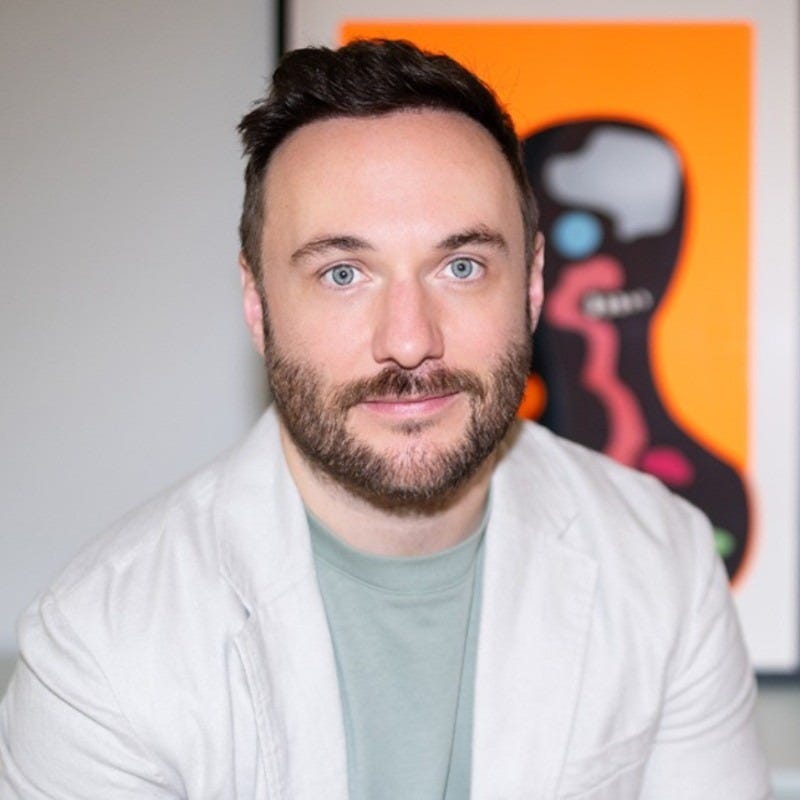
Education and Professional Highlights
Currently: Independent Product Ops Consultant and Coach based in London. Founder of his own practice helping leaders build modern product operating models. Co-founder of the Product Ops Collective.
Career arc: Graphic designer → UX/UI designer → product design → product management and strategy at Thoughtworks → Product Operations Principal at Farfetch → Product Operations Lead at Bumble → independent consulting, speaking, and writing.
Companies: Thoughtworks, Sky, Sainsbury’s, Farfetch, Bumble, Reward Gateway, and more across 20 years spanning Europe and the US.
Originally from: West Yorkshire, England. Has the outgoing personality to prove it, per his partner, who said it immediately when he asked what Yorkshire gave him.
Based in: South London. Garden and a glass of wine on a Thursday evening when the weather cooperates.
Outside work: Hiking, learning to make music with synthesisers, street photography. Can talk about almost anything easily, and will, if you give him an opening.
Speaking: Over 10 years on international conference stages - Product at Heart, Product Ops Summits, Productized Lisbon, Product Leaders Vilnius, and many more.
Forthcoming: A book on product operations! A practical action guide connecting what ops people do to business value and impact. He has been developing the approach for a while. I can tell this one will be worth the wait.
A Clothes Shop in Yorkshire
Chris grew up in West Yorkshire, in the north of England, and when I asked what that gave him before any career existed, he had an immediate answer: building strong relationships.
But the story that opened something for me was from when he was fifteen. His father owned a clothes shop in a small Yorkshire town. Chris, feeling unconfident despite being good at making friends, asked to work in it. His father put him behind the counter, and didn’t come back until the day was done.
Suddenly Chris was selling jeans to blue-collar workers in their forties and fifties, reading people in real time, figuring out how to understand what they actually wanted and finding a way to get there together. He did not know it then, but he was learning the thing that would define his entire career: how to win others over - not through persuasion tactics, but through genuine understanding of what the person in front of you actually needs.
That experience eventually became a talk he gave called How to Woo. The word woo, he discovered when his Turkish partner asked what on earth it meant, stands for Winning Others Over as defined by the Clifton Strengths assessment. He is, in his words, okay with that. Fun fact - I had zero idea what that stood for until that moment either.
Before tech, he was a graphic designer - first at a traditional fashion company, then at a paint manufacturer, neither particularly inspiring, but the second introduced him to a book from 1928 that he still thinks about today. Die Neue Typographie by Jan Tschichold. A German typographer writing nearly a century ago about visual communication, structure, and how to draw attention to what matters. Chris does not read it as a design manual. He reads it as an operating philosophy, and he applies it to product ops.“Nothing we do is really new. Those concepts were built upon prior concepts in the past. And I’m quite comfortable with that now.”
He used to feel like creating something new was the point. He has made his peace with the idea that building on what already works, clearly and well, is enough.
How Product Found Him
Chris is disarmingly honest about his own limitations, and it has served him well throughout his career. He realized early in his design years that he was not going to be good enough for the London ad agency roles. He did not have the formal training. The raw creative talent those seats required was not his particular gift. So rather than fight it, he jumped sideways - from graphic design into UX design, at a moment when he did not even fully know what the word meant.
He grew that into product design, then product strategy through his time at Thoughtworks, and along the way had the realization that changed everything. “I realized that my skills, capabilities, and desire led to the enablement of other people. That’s how I went into product operations.”
He was not drawn to building the product. He was drawn to building the conditions in which great products get built. All the goosebumps from this lady right here. The clarity, the systems, the working groups, the frameworks that let good people do their best work without friction eating up all their energy. Once he understood that was his thing, the career clicked into place.
Thoughtworks to Farfetch to Bumble, carrying the same orientation through every context: how do we make this organization healthier, clearer, and faster, without me being the one who has to do everything? Then he went independent after Bumble, bet on himself with no immediate clients lined up, and has not looked back.
The Discipline: What Product Ops Actually Is
Chris has a definition of product operations that he has refined over twenty years and returns to consistently. I want to give it the space it deserves.
“Product ops is an enabling function. Its purpose is to increase the quality of decision-making across the product development lifecycle. Not just efficiency or alignment. Decision-making quality.”
He is precise about why those other words fall short. Efficiency and alignment are means, not ends. They are things that enable good decisions - but the thing you are actually after is empowered product teams that can make the right calls quickly, because they have everything they need: the data, the tools, the strategic context, the clarity about what decisions are theirs to make. “The best product teams are empowered to make decisions themselves. They can do it very quickly because they’ve got everything on hand and they know the boundaries they can operate in.”
On why naming and formalizing the function matters, he reached for something from his Thoughtworks years that has stuck with me. Once you pin something up on the wall, you can throw tomatoes at it. Meaning: once it is named, it can be interrogated, communicated, pointed at, refined. It stops being something that happens in the shadows and becomes something the organization can actually have a conversation about.
He also makes a point that I think every product leader reading this needs to sit with. Someone in a scaling organization needs to be thinking seventy-five percent of the time about how that organization is structured, how it operates, how it communicates, and how it stays aligned. Right now, that seventy-five percent lands on the VP of Product or CPO who is also supposed to be setting vision, strategy, and direction. That is not sustainable. Product ops exists, in part, to take that weight off the people who should not be carrying it.
What One Person Can Actually Do
At Bumble, Chris was the sole product ops person supporting between ten and fifteen product teams. He mapped it out for me clearly, and it’s one of the most practically useful things I have heard anyone say about how ops work actually scales:
He started by mapping resources - not headcount, but the full picture. Physical time. Mental time and space. The capabilities of the people around him. Any budget available to make change happen.
And then he mapped incentives, because you can have all the resources in the world and nothing will move if there is no reason for people to care. He identified three that actually work:
growth (learning new skills, working across the organization),
recognition (standing up at the all hands, being seen),
monetary reward (bonus, salary, promotion, etc.)
With one person, he calculated he could drive roughly one meaningful change initiative per year before the effort outpaced the return. So he stopped trying to do it alone.
He relied on operational working groups. Cross-functional, cross-seniority, given a clear mandate and the resources to act on it, with product ops coaching and guiding rather than directing. Some he stayed close to. Some he handed off entirely. Both worked, depending on the readiness of the people and the organization.
“You’re not directing the change. You’re cultivating it. So people care about organizational evolution rather than just being told what to do.”
This is product ops at its most effective and, honestly, its most satisfying - not the person doing the work, but the person building the conditions in which the right work gets done by the right people.
Why the Value Question Is Still Not Resolved
After the better part of a decade of product operations existing as a recognized function, the value question should be settled by now. Chris is clear-eyed about why it is not, and he breaks it into three parts:
The first is genesis. When product ops emerges from internal need, it often gets positioned as the team that picks up whatever nobody else wants. When it is brought in externally, teams fear it will standardize the things that should stay flexible. Neither starting point gives the function room to demonstrate what it actually does.
The second is language. Product ops people tend not to be the loudest people in the room. Product managers, the best ones, are constantly connecting their work to outcomes, making it visible, articulating value upward. Product ops people, by disposition, are often less comfortable doing that. And when the work is invisible by design - because it is working - that silence gets misread as absence.
“When it’s been done really well, you don’t realise it exists. Which makes the second piece - putting your hand up and saying ‘by the way, I’m doing these things’ - even more important.”
The third is the sharpest version of this problem I have encountered:
Business leaders care about five things. Making more money, reducing costs where possible, acquiring new customers, engaging existing customers, and increasing shareholder or investment value.
Product ops has to speak that language. Not the language of frameworks and processes and tooling - the language of the room it is trying to influence. When a product ops person can connect what they are doing, even something as tactical as improving how Jira is structured, to one of those five outcomes, the conversation changes entirely. Until they can do that, the value question will keep coming up.
This is also at the heart of the book he is writing - a practical action guide that connects what product ops people do to the business value and impact that actually matters to the people holding the budget.
On AI and the Generalist’s Return
Chris is not someone who performs urgency about AI. He is someone who gets quietly frustrated by the people selling urgency about AI, which is a more useful position.
He described a conference where the opening speaker declared that every organization must hire only people with AI capabilities - then closed by selling ten AI courses. He is actively trying not to produce that kind of content (thank you Chris). His actual view is grounded: if you are a highly capable person and the need arises to pick up an AI tool, you can learn it in a week. Because you have spent a career adapting. If you have hired people who cannot do that, the problem existed before AI arrived.
Where he sees AI genuinely helping: synthesis of ideas, opening paths to concepts and thinkers he would not have found on his own, having an instant sounding board for half-formed thinking. Where he sees it creating problems: over-reliance, reaching for the tool before doing the thinking, and an industry manufacturing fear not because fear is warranted but because fear sells.
The skill he thinks product and ops leaders are most dangerously undervaluing right now is generalism. The past several years have driven organizations toward hyper-specialism - understandable given the volume of available talent after waves of layoffs - but he sees that reversing. AI is good at deep specialism. It is not good at navigating genuinely ambiguous problems with creativity and judgment. That is the generalist’s territory. “Product development has always favored people who are generalists. People who can connect the dots, be creative and innovative. And I’m starting to see that uptick again.”
He hopes it is a correct take. I think it is.
Product Is a Way of Life
The most unusual thing Chris told me - and I mean that as a compliment - is something he did during his time at Farfetch. For three months, he tracked every hour of every day. Not what he did. How he felt doing it. He was mapping his energy, looking for patterns, trying to understand himself the same way he would try to understand a system he had been asked to improve.
What he found: he is significantly more energized on Thursday mornings than at any other time in the week. He now books workshops and talks accordingly. He knows he is a starter and an energiser, not a finisher of fine detail. He has built his independent practice around that self-knowledge rather than against it.
He thinks more people should do some version of this, and I agree with him. Not the full three-month mapping exercise necessarily, but the underlying question - when does your energy actually show up, what kind of work lights you up, where does the battery drain - is one that most working environments never create space to ask.
The most consistent factor he sees holding product organizations back, across every company size and stage he has worked with, is what he calls ultimate clarity. YES! Everyone in the product organization must share a common, continuously communicated understanding of the product’s vision, strategy, language, metrics, and decision-making boundaries. When that exists, teams move fast because they know what they are moving toward. When it does not, even very talented people spend enormous energy on the wrong things.
He has seen this in a six-person startup. He has seen it in an organization of eighty thousand. The problem is the same. The solution is the same. Clarity is not a leadership nice-to-have. It is the operating condition for everything else.
The People Who Changed Everything
Esra, his partner and fellow product consultant, is first. She hears all of this daily - every half-formed idea, every client challenge, every moment of doubt. He is matter-of-fact about what that means and clearly does not take it for granted. Having someone that close who actually understands the work at that level is rare.
Hugo Froes, who he has known since 2014 and who calls him his human GPT - a title Chris accepts cheerfully and returns in kind. Over a decade of keeping each other honest, checking each other’s thinking, and pushing back when needed. That kind of long-term intellectual partnership is something most people do not have and do not realise they are missing.
Dr. J Harrison from Thoughtworks gets credit for something foundational - the understanding that inclusivity drives diversity, which drives creativity, which drives customer value, which drives business impact. That chain is not abstract for Chris. It is the operating model he has built his entire practice around, and he traces it directly to that relationship.
What He Wishes You Would Ask
I always end with the same question: what do you wish someone would just ask you that nobody ever does? Chris had an answer ready, and I think it might be the most quietly important thing in this whole piece.
He has spent years tracking his own energy, understanding his personality, figuring out what kind of work lights him up and what depletes him. He is highly extroverted in the way that many people who are very good at rooms actually are - high social energy output, but with a battery that empties fast, and a real need for silence to recover. And he thinks we should all be talking about this more, in our teams and in our organizations, because the way a team is structured, when its standups happen, how it collaborates, all of it should account for the fact that different people are wired differently.
“Being more open about our personality types and how we operate would lead to way better collaboration. If you can bring your whole self to work without fear of reprisal - that’s when you know you’ve got a good culture.”
Twenty years of building that kind of culture for product organizations. The same belief, the same standard, applied to himself and to every team he has ever worked with.
I have been doing this series for a while now, and the moments I remember most are the ones where someone says something quietly true that most people are too busy or too guarded to say out loud. Chris said several of those things in one conversation. That is a rare thing, and I am glad I finally sent that LinkedIn message.
You can find Chris Compston on LinkedIn, at chriscompston.com, and on Substack.
If you are a product leader trying to build a healthier, clearer, more effective organization and want to work with someone who has actually done it - reach out to him. Tell him I sent you.